


SPL
SPL Director Mk 2
- Regular price
- €3.799,00
- Regular price
-
- Sale price
- €3.799,00
- Unit price
- per
Preis inkl. MwSt. zzgl. Versandkosten
- €3.685,03
Wir schicken Ihnen dann eine korrigierte Rechnung inkl. 3 % Skonto per Email.
Weitere Fragen?
Skonto (Vorkasse per Banküberweisung -3%)
Product description
Product description
The core of the system is the preamplifier. With remote-controllable source selection and volume control, a tape monitor loop, retro-look VU meters, a premium DAC, and the superior VOLTAiR technology, the Director Mk2 delivers musical blockbusters.
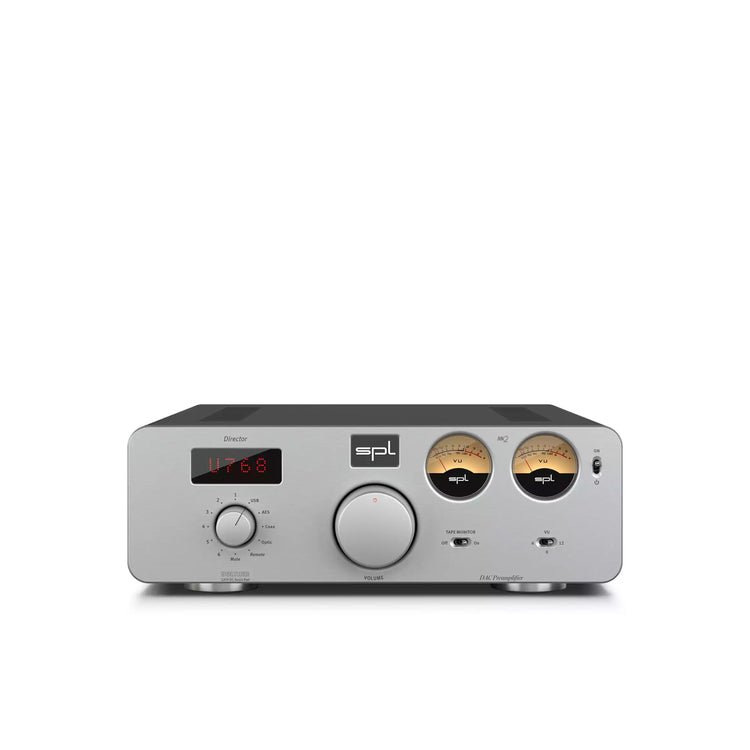
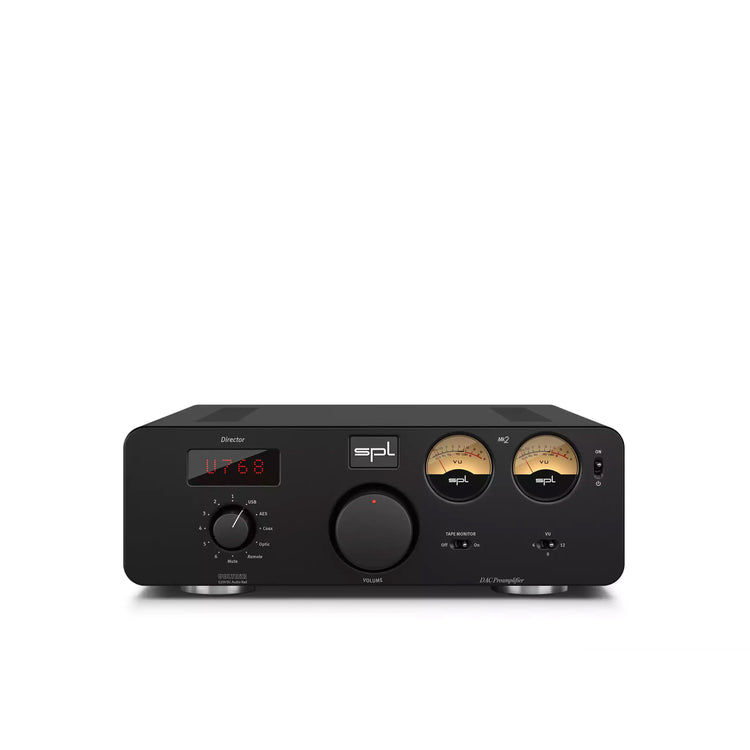
The massive 45mm volume knob, milled from aluminum, is a haptic highlight. In combination with the motorized Alps RK27 "Big Blue" potentiometer, its mass creates a wonderful "spoon in honey" rotation feel.
The red LED marker ensures the volume parameter is clearly visible even in darkened environments.
Both volume and source selection can be controlled remotely using any infrared remote control.
The Director Mk2 learns to communicate with it at the simple push of a button.
A source of joy
Up to ten (10!) stereo sources can be connected to the Director Mk2.
Six of these are for analog input signals, and four are for digital ones.
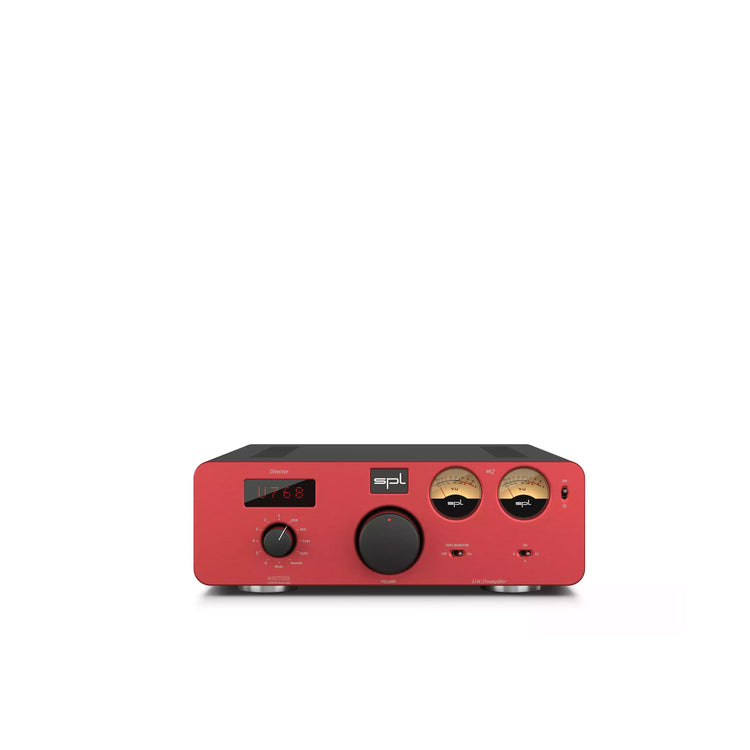
The source selection is indicated on the dot-matrix LED display: IN 1 through IN 6 for the analog inputs; AES, USB, COAX, OPTICAL for the digital inputs. After approximately two seconds, when a digital source is selected, the display shows the detected sample rate. For example, U768 = USB input with a 768 kHz sample rate.
The source selection can be remote-controlled when the rotary switch is set to the "Remote" position.
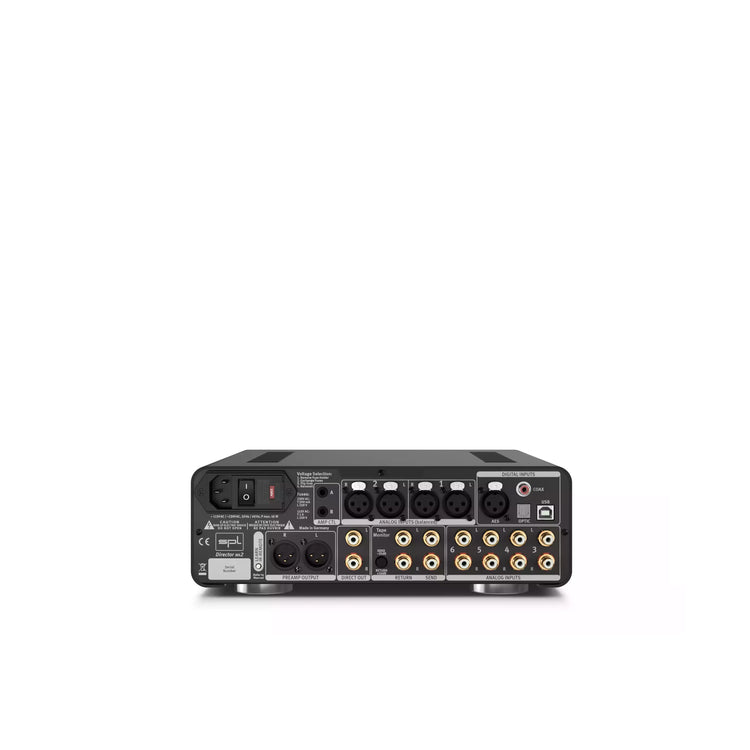
The Director Mk2 offers two pairs of balanced inputs with XLR sockets and four standard inputs with gold-plated RCA sockets.
On the digital side, four additional inputs are available. PCM audio is received in S/P-DIF format via coaxial (RCA), optical (Toslink F06), and balanced (AES/EBU) connections. USB allows for the conversion of both PCM audio and DSD audio.
The DAC automatically adopts the sample rate and resolution of the digital playback source. It doesn't matter if you have connected a streamer, computer, or CD player. No further settings are required on the Director Mk2.
The detected sample rate is shown on the dot-matrix LED display. For instance, U768 is an acronym for the "USB" source with a sample rate of 768 kHz.
The highly acclaimed AKM AK4490 Velvet Sound™ premium DAC chip is used as the converter chip, which reproduces the finest sound details thanks to its architecture.
It converts PCM audio with a resolution of 32 bits and a sample rate of up to 768 kHz, which corresponds to 16 times the resolution of a CD. Direct Stream Digital is also supported up to a resolution of DSD4 or DSD256. Unlike the DAC768xs, the DAC768 offers not only an AES/EBU digital input but also the SPL DLP120 with VOLTAiR technology.
Every signal that is passed from a DAC chip into the analog world must be filtered by a low-pass filter. The DLP120 contains two of them: one for PCM audio signals and one for DSD audio signals, as different roll-off frequencies are required.
Unlike any other DAC in the world, our analog low-pass filters utilize SPL VOLTAiR technology, which provides a plus in dynamics, headroom, and sound.
Two mechanical VU meters visualize the input levels for the left and right audio channels.
You can use the VU switch to optimize the display for different signal levels.
Tape monitoring
A tape monitor circuit is quite retro.
Who still owns a cassette recorder or a reel-to-reel machine?
Who still loops in an equalizer?
Asked differently:
Who would like to, but can't because no manufacturer offers a tape monitor circuit anymore?
Well, those who want to can now do so again.
Today's audio levels are significantly higher than they used to be, and many a recorder could be "overdriven."
Here, too, the Director Mk2 offers a solution. At the simple press of a button, the level sent to the recorder is lowered by 10 dB and boosted by 10 dB after the recorder. Et voilà.
The Director Mk2 features two stereo output pairs for connecting power amplifiers or active speakers.
One pair has XLR outputs, the other has RCA outputs. Both carry the same output signal, which is controlled by the large volume knob. This allows one pair of speakers to be played via one stereo output and a subwoofer via the second. The playback volume for both stereo outputs is adjusted together using the volume knob on the Director Mk2.
Using DIP switches on the rear of the device, the volume control for the RCA and XLR outputs can be bypassed separately from the signal path – this turns the corresponding output into a "slave thru," for example, to connect a headphone amplifier with its own volume control. When the slave-thru mode of a stereo output is active, the volume control of the Director Mk2 no longer affects the playback volume of the connected headphone amplifier.
As of hardware revision 2.2, the Director Mk2 features a Home Theater Bypass. This allows the Director Mk2 to be used in combination with a multi-channel home theater system. The L and R channels of this home theater system are simply connected to Input 6 of the Director Mk2. If Home Theater Bypass is active (DIP 4), this signal is no longer affected by the volume control on the Director Mk2.
Via AMP CTL, the standby mode of devices with a 12V trigger input can be switched on and off together with the Director Mk2. This allows power amplifiers such as the SPL Performer s800, Performer m1000, or Performer s1200 to be perfectly integrated into the setup.
For all devices in the Professional Fidelity series, we develop not only according to plans from the start, but also by ear. Many of the fundamental components are installed on the circuit boards using through-hole technology (THT). This allows us to ensure that we use the components that sound the best.
Technical details
Technical details
Product safety
Product safety
Herstellerangaben:
SPL electronics GmbH
Sohlweg 80
41372
, Niederkrüchten
Germany
info@spl.audio
Financing options
Calculate your financing installments without obligation and check different terms.